

Writing & MediaFree tool
Repetitive Word Finder With Fixes in Context
The echoes, pet words and repeated sentence openings a reader would notice, marked in your draft, each with a fix that suits its sentence.
Free to start · Opens in your River workspace, ready to edit and share
How to find and fix repetitive words in your writing
In writing, repetition becomes a fault when a word, phrase or sentence pattern returns close enough for a reader to notice. Think of a distinctive word twice in one sentence, a pet phrase on every page, or three sentences in a row that open alike. To find repetitive words, judge each repeat by how close and how unusual it is, not by a raw count. Keep the repetition that does a job, and fix the rest by cutting or rebuilding the sentence before you reach for a synonym.
The question is never how many times a word appears, but whether a reader will hear it twice. "The" can turn up in almost every line unnoticed, while "pivotal" twice in one paragraph sounds careless.

Know which repeats readers notice
Distinctive words echo loudest. The UNC Writing Center's editing handout asks whether you repeat a strong word, such as a vivid main verb, unnecessarily1. Next come the small habit words a writer stops seeing, then the patterns: sentences that open alike or share one shape.
Six kinds of repetition and what to do
| Kind | Example | What to do |
|---|---|---|
| Echo | "The results were striking, and the most striking was the cost." | Rebuild it: "The cost was the most striking result." |
| Pet word | "Navigate" in every section of a report | Search for it and keep only the uses that earn their place |
| Filler | "This is really just a very simple fix." | Cut them: "This is a simple fix." |
| Same opening | "This shows… This means… This is why…" | Merge two, or open one with its real subject |
| Same shape | Five sentences in a row, each two clauses joined by "and" | Split one, join two, vary the length |
| Refrain | "We will… We will… We will…" in a speech | Keep it, because you chose it |
Find repetitive words by ear and by search
Leave this pass until late. Settle structure and argument first (for a novel, a self-editing checklist covers the big checks), because there's no point polishing a paragraph you may cut. Then give the draft a day if you can, so you read what is on the page rather than what you meant.
Read it aloud
The UNC Writing Center counts "too repetitive" among the awkward sentences that are often easily heard2. A text-to-speech voice helps, since it won't smooth over what you skim.
Give each sentence a line
On a copy, press Return after every period, a trick UNC suggests for reading every sentence carefully1. Repeated first words then line up down the left edge.
Search for suspects
Use Find on each word you lean on and step through every hit. Start with the words Purdue OWL says are often used as filler3, such as really, basically, actually and kind of.
Count what stands out
A word-frequency list helps if you skip its top. Ignore "the," "and," your subject and your characters' names, and read the distinctive words below them.
Keep a list of your habits
Pet words travel from draft to draft. Write yours down as you find them, and search for them first next time.
Keep the repetition that does a job
Some repetition is there for the reader. In instructions, contracts and reports, a key term should stay the same every time. The US government's plain language guide gives the example of "senior citizens" and "the elderly"4: switch between them, and readers may wonder whether you mean the same group. Record your key terms in a house style guide so every writer uses the same ones.
Fiction has its own invisible words. In a 2010 Guardian feature collecting writers' rules, Elmore Leonard's third rule is to carry dialogue with "said" and no other verb5. "Said," he wrote, is "far less intrusive" than "grumbled" or "gasped." Names work the same way. Once a character is Dana, keep her Dana (or "she"), not "the tall woman" in the next line.
Deliberate repetition can be the whole point. The 1920 edition of William Strunk Jr.'s The Elements of Style asks for parallel form for parallel ideas6, citing the Beatitudes, where line after line opens "Blessed are." Unskillful writers often break the rule, Strunk wrote, out of "a mistaken belief" that they should "constantly vary the form." The UNC Writing Center also accepts repetition used to emphasize a point7, as long as it is a conscious choice.
Fix it without reaching for a thesaurus
The reflex is to swap in a synonym, and it often makes things worse. UNC's editing handout warns against thesaurus words outside your normal vocabulary1, since you may misuse them. In the same Guardian feature, the novelist Roddy Doyle advises keeping a thesaurus in the shed at the back of the garden or behind the fridge5. Try these fixes first, roughly in this order:
- Cut the word, if the sentence works without it.
- Merge two sentences. Purdue OWL turns "five tellers. These tellers…" into "five tellers, who…"3.
- Use a pronoun, but only where it can point to one thing.
- Restructure. When several sentences in a row each join two clauses with "and" or "but," Strunk's advice was to recast enough of them to remove the monotony6.
- Change the word, but only for a more exact one.
Before: Nora opened the envelope slowly. She read the letter once, then she read the letter again. She just sat there for a minute. She looked at the window, and then she looked at the phone. "I got the job," she said, and she really couldn't believe it.
After: Nora opened the envelope slowly. She read the letter once, then again. For a minute she sat still, her eyes moving from the window to the phone. "I got the job," she said. She couldn't believe it.
- An echo cut. The second "read the letter" became "then again." The reader knows what she's reading.
- Two looks merged. Both "looked" clauses folded into one sentence, with her eyes doing the moving. No synonym was needed.
- Openings varied. Three sentences in a row began with "She." Opening one with "For a minute" breaks the run.
- Fillers out. "Just" and "really" added nothing, and the last line lands harder without them.
- One word kept. "Said" stays. It is the speech verb readers don't notice.
Check the whole draft before you finish
Long pieces hide their own patterns: a character who shrugs in every scene, a phrase that opens three chapters, or "That said" starting every other section. Read your chapter openings side by side, and search the whole draft for each word you flagged along the way.
With the repeats gone, the sentences around them may still feel loose. A line editor tightens a page in your voice, and a passive voice checker catches another habit that pads prose.
Before you call it done
- No distinctive word twice in a sentence unless you meant it
- No run of sentences that open the same way by accident
- Fillers such as really, just and very cut where they add nothing
- Key terms, names and "said" left as they are
- Every refrain and parallel list is one you chose
- The whole draft read aloud at least once
Doing all this by hand on a long draft takes more than one sitting. The tool at the top of this page reads your draft the same way, weighing how close and how unusual each repeat is. It leaves a comment with one fix on each repeat worth changing, for you to accept or ignore.
How it works
Paste your draft into the box or attach the file; River works through a long manuscript chapter by chapter. It weighs distance and distinctiveness, not raw counts, and ignores the repetition you need: names, key terms, refrains. Each echo, pet word or repeated opening worth changing gets a comment in your document with one fix, chosen for that sentence. A table at the end counts your most overused words, and your sentences stay as you wrote them until you ask for the fixes.
Paste your draft
Paste the text or attach the file, anything from a single page to a full manuscript.
River weighs each repeat
Close repeats of unusual words count most. It skips names, key terms and the refrains you chose.
Read the comments
Each repeat worth changing gets a comment with one fix, plus a table of your most overused words.
Choose your fixes
Ask River to apply the fixes you agree with, or check the same draft for passive voice next.
What you get
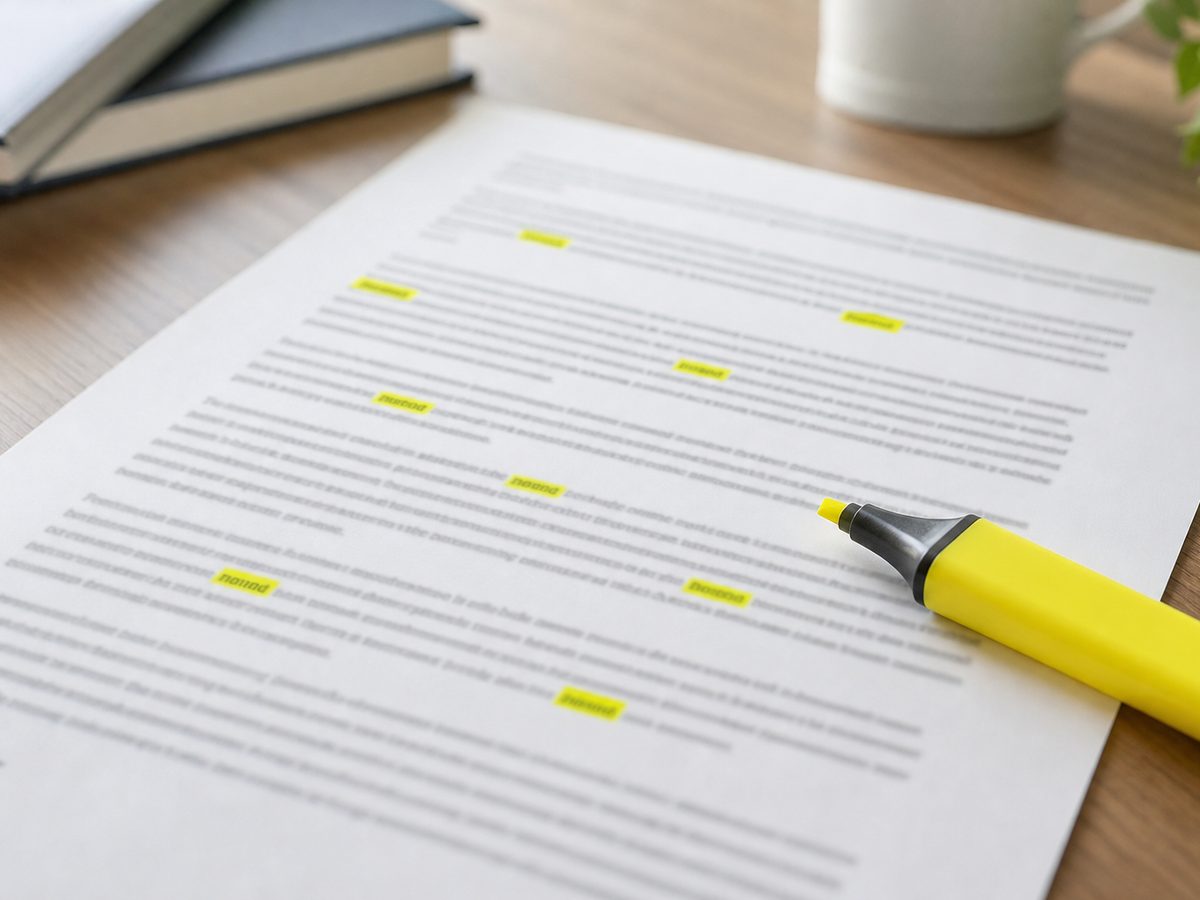
- Echoes marked where they happen, such as one distinctive word twice in a sentence or paragraph
- Pet words and fillers such as really, just and very, flagged where they pile up
- Sentences and paragraphs that open alike, and runs of sentences that share one shape
- One fix per comment, picked for that sentence: cut, merge, pronoun, restructure or a better word
- Names, key terms and repetition you chose left alone, with a note when River isn't sure
- A table of your most overused words with counts, plus the two or three habits to fix first
Common questions
What does a repetitive word finder do?
A repetitive word finder scans your writing for words, phrases and sentence openings that come back often enough, or close enough together, to catch a reader's ear. Simple ones just count every word, which often puts "the" and your main subject at the top of the list. Better ones judge each repeat in context and suggest how to fix it.
How many times can you repeat a word in writing?
There's no set limit. Common words like "and" or "said" can appear on every line without anyone noticing. A distinctive word such as "luminous" is another matter, because readers tend to catch it the second time it shows up nearby. As a working rule, look twice at any unusual word that returns within a few sentences, and at every word on your list of habits.
How do I find repeated words with River?
Paste your draft into the box at the top of this page, or attach the file. River reads it for noticeable repeats, comments on each one with a suggested fix, and adds a table of your most overused words at the end. It all opens in your free River workspace, where you can apply the fixes you like.
Will it replace my words with synonyms?
Not on its own. River suggests one fix per repeat in a comment and changes nothing until you ask. The fix might be to cut a word, merge two sentences, use a pronoun or rebuild the sentence. When a different word is right, River offers one at least as precise, and it never trades a key term, a defined term or a name for a vaguer word.
Can it check a whole book manuscript?
Yes. Attach the manuscript and River works through it chapter by chapter. The table at the end shows where your most overused words cluster, so a character who nods through every chapter stands out. Run it late, once structure and plot are settled; for those bigger questions, start with the AI book editor.
Is repetition always bad in writing?
No. Repeating a key term keeps your meaning steady, a parallel list is easier to follow, and a refrain can carry a speech. What to cut is repetition nobody chose: the same unusual word twice in a sentence, a filler on every page, or a run of sentences that all begin with "This." If you meant it, keep it.
Is the repetitive word finder free?
Yes, it is free to start. Your marked-up draft opens in a River workspace, where you can edit it, share it or ask River to change it. Paid plans add more AI use and access to the most advanced models.
Sources
UNC Writing Center. “Editing and Proofreading.” writingcenter.unc.edu (opens in a new tab)
UNC Writing Center. “Reading Aloud.” writingcenter.unc.edu (opens in a new tab)
Purdue University. “Eliminating Words.” owl.purdue.edu (opens in a new tab)
Digital.gov. “Short and simple.” digital.gov (opens in a new tab)
The Guardian. “Ten rules for writing fiction.” theguardian.com (opens in a new tab)
Project Gutenberg. “The Elements of Style by William Strunk.” gutenberg.org (opens in a new tab)
UNC Writing Center. “Writing Concisely.” writingcenter.unc.edu (opens in a new tab)
Built by
Chandler Supple
Co-founder & CEO, River
Chandler has spent the last six years working in AI, building tools for millions of users and Fortune 100 companies. In 2025, he co-founded River to build a new kind of operating system for AI agents.